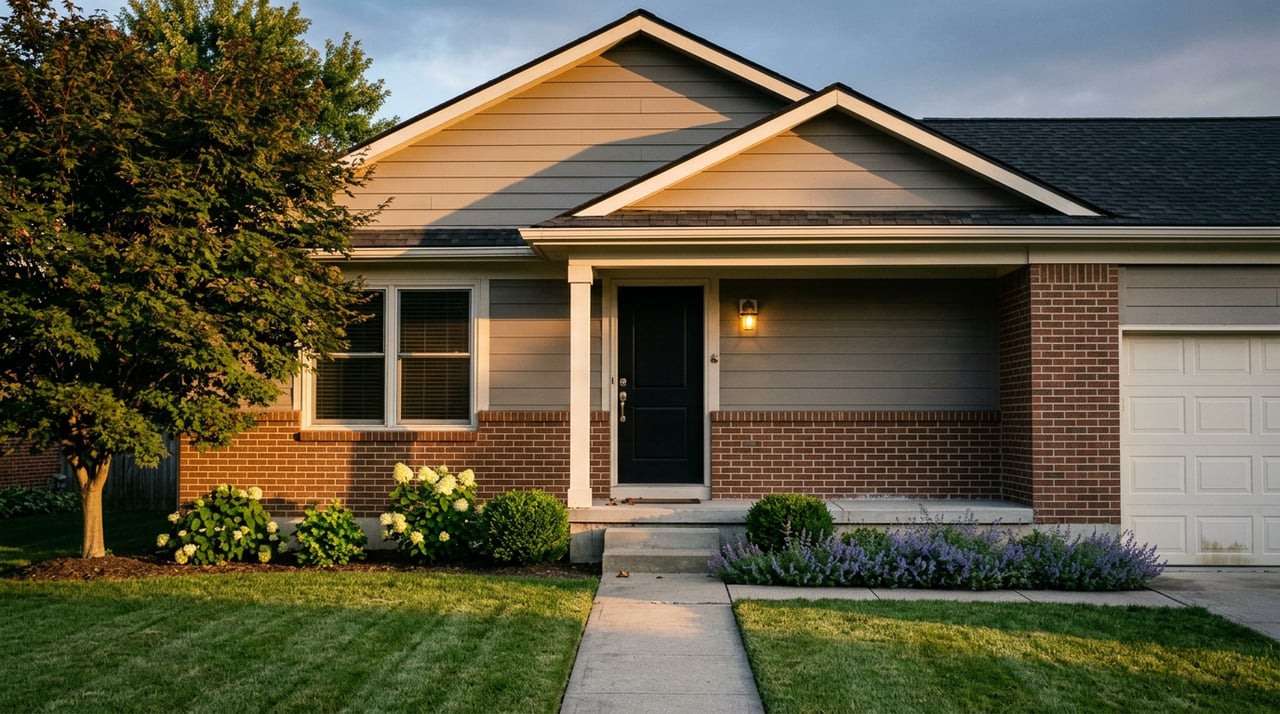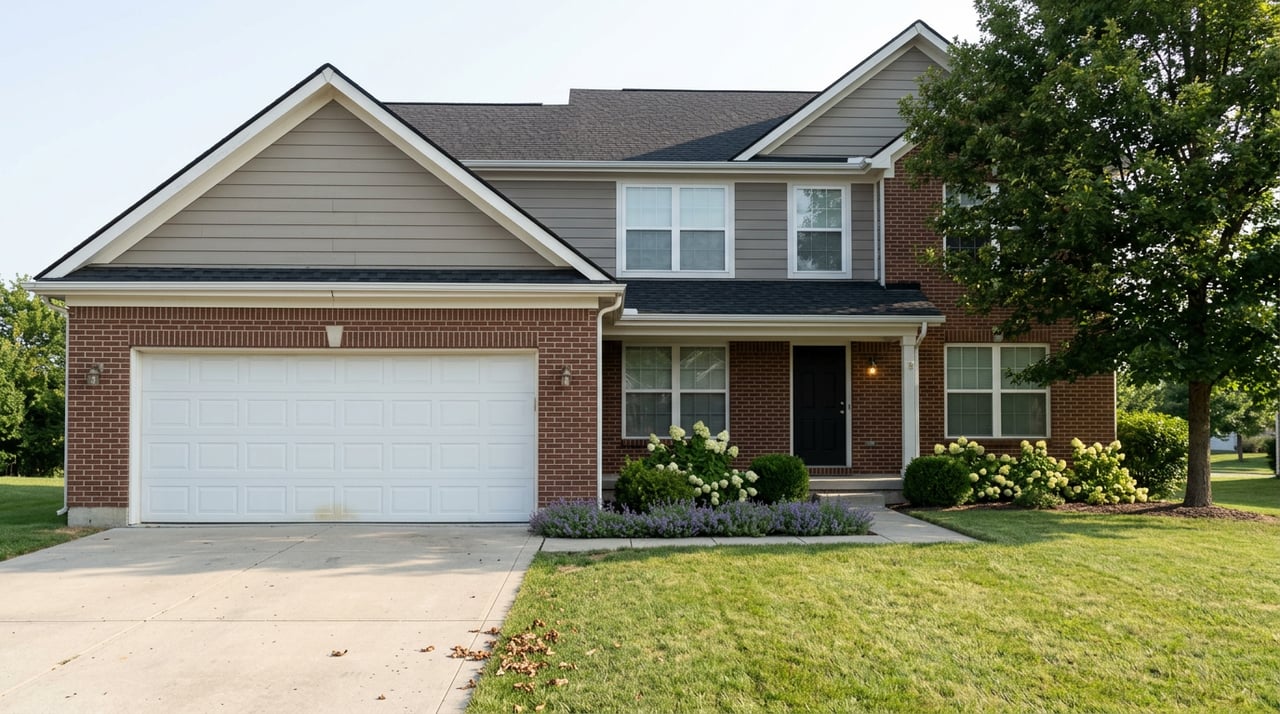
A homeowner in the Talon's Reach subdivision east of State Road 3 pays property taxes to the Town of Huntertown, gets water and sewer service from Huntertown, and votes in Huntertown town elections. Their mailing address still says Fort Wayne. That is not a clerical error. It is the leftover fingerprint of an annexation strategy that quietly built most of what people now call Huntertown, and it is the reason nobody researching this market right now can get a straight answer on where prices are headed.
If you are comparing Huntertown to other Fort Wayne-area suburbs, the median price you see on any given site is less useful than understanding what that median is actually measuring. Here is the mechanism behind it.
A town that grew by annexing, not just building
Huntertown's population jumped by roughly 90 percent between the 2010 and 2020 census, rising to 9,141 residents and making it one of the fastest-growing towns in northeastern Indiana. That is a startling number for a town that had hovered near 5,000 residents for the prior decade. It didn't happen because Huntertown families suddenly started having more children. It happened because Huntertown, once a sewage treatment plant upgrade freed up capacity for new connections, began actively courting developers to annex their subdivisions into town limits before the first house was even built.
The town's own annexation records show the pattern in black and white, and a 2019 Journal Gazette investigation named the projects: Rolling Oaks, a 218-home development by Oakmont Development on the former Willow Ridge golf course; The Quarry, a two-section project from Roger Delagrange and The Chestnut Group adding roughly 105 homes off Cedar Canyons Road; The Cliffs of Rolling Oaks, 15 homes from Quality Crafted Homes; Brownstone, a 243-acre annexation along Lima Road, Shoaff Road, and State Road 3 with dozens of existing and planned homes; and Talon's Reach, a roughly 530-home annexation east of State Road 3. Council President Brandon Seifert described the ambition plainly, comparing Perry Township's trajectory to Aboite Township's boom in the mid-1990s: "We are the Aboite Township of now."
That comparison was deliberate policy, not marketing.
The town limit is smaller than the address suggests
Here is the part that matters for anyone actually shopping this market. As of the 2010 census, the incorporated Town of Huntertown covered just 3.81 square miles. Perry Township, the larger civil township that surrounds and contains it, covers 35.63 square miles. Most of what carries a Huntertown mailing address, and nearly everything that shows up when you search "Huntertown, IN" on a listing site, sits somewhere in that much larger township footprint, not necessarily inside the town's actual governing boundary.
That gap is why the Talon's Reach detail matters beyond trivia. When that annexation went through, the homes kept their Fort Wayne mailing address even though the town took over their water, sewer, and trash service and added them to its tax rolls. Address, school assignment, utility provider, and taxing authority can all diverge on the same street, sometimes on the same block, depending on which side of an annexation line a parcel falls on.
Why the price trackers can't agree right now
This geography problem shows up directly in the numbers. As of July 2026, one automated valuation model put Huntertown's median home value at $339,068, up 13.27 percent year over year. As of August 2026, another tracker showed the median list price at $395,000, down roughly 4 percent from a year earlier and down about 5 percent from the prior month. Two datasets, both labeled Huntertown, telling close to opposite stories about direction.
Actual closed sales in the 46748 zip code from July 2026 show why blending these areas produces noise. One four-bedroom home built in 2016, at roughly 2,750 square feet, closed for $445,000 on July 30 after 66 days on market. A newly built four-bedroom, at roughly 2,270 square feet and completed in 2026, closed for $629,900 on July 15 after just 39 days on market. Those two sales alone span nearly $185,000, and both are legitimately part of the "Huntertown" dataset. When your numbers mix long-established in-town subdivisions with brand-new custom construction in unincorporated Perry Township parcels that merely share a zip code, a single median line is going to bounce around in ways that have nothing to do with underlying demand.
If you're pricing a purchase or comparing Huntertown to a neighboring suburb, the median alone will not tell you what a specific parcel, in a specific subdivision, on a specific side of an annexation line, is actually worth. That is a job for a comparable-sales analysis grounded in the parcel's real location, not the zip code it happens to share with a much larger area.
The growth engine hasn't stopped, it's just changed shape
Population growth inside the town's own borders has slowed sharply compared to the 2010s. Current estimates put Huntertown's population near 11,600 to 11,700 people and growing at under 1 percent a year, a fraction of the prior decade's pace. That does not mean the area has cooled. It means the growth has shifted from residential annexation to commercial infill and new subdivisions further out in the township.
The clearest evidence is Huntertown Crossing, a $76.4 million mixed-use development that Parkview Health representatives presented to the Huntertown Town Council and Redevelopment Commission in December 2025. Planned for 34 acres at the northeast corner of State Road 3 and Gump Road, the project includes a Parkview medical office building that was already nearly complete at the time of the presentation, commercial strip centers, restaurants, a grocery store, 150 market-rate apartments, and a 75-unit senior living complex. The town approved $8.1 million in infrastructure financing through the Indiana Finance Authority to support it, and Fort Wayne Business reported the full build-out is expected to take several years.
Enrollment pressure tells the same story from a different angle. Northwest Allen County Schools is opening Willow Creek Middle School this fall after spending the prior winter rebalancing attendance boundaries, because Carroll and Maple Creek middle schools were, in the superintendent's words, "bursting at the seams." The district's own materials point to continued growth in the northwest Allen County area as the driver behind the new building and the redrawn lines.
Meanwhile, builders keep platting new ground on both sides of the annexation question. DR Horton is actively selling homes in the Marcella subdivision starting in the $300,000s. Granite Ridge Builders has a luxury model under construction in Simon Lake Estates. Bob Buescher Homes has a ranch under construction in The Pines with an estimated December 2026 completion. At the high end, Shadow Creek has listed a custom estate near 9,300 square feet with a golf simulator and dedicated whiskey and wine rooms. That range, from entry-level production homes to seven-figure custom builds, is itself a sign that Huntertown as a market now spans several very different buyer profiles under one town name.
What this means if you're comparing Huntertown to somewhere else
If a listing's price per square foot or year-over-year trend seems inconsistent with what you're seeing elsewhere, ask a more specific question before you assume the data is wrong: is this parcel inside the actual Town of Huntertown, or in the unincorporated part of Perry Township that shares its name and zip code? The answer affects your property tax rate, which utility provider bills you, which municipal services you're entitled to, and which specific subdivisions your comps should be drawn from.
This is exactly the kind of detail that a valuation grounded in appraisal method, not just an automated model pulling from a zip code, is built to catch. If you're weighing a move to Huntertown against another Northeast Indiana suburb, or trying to figure out what a specific address is actually worth once you account for its real jurisdiction, Daniel Morken can walk through the comparable sales and the parcel-level details that a median price will never show you.
Quick answers
Does a Huntertown, IN mailing address mean I'm inside the town limits? Not necessarily. Some annexed subdivisions, including Talon's Reach, kept a Fort Wayne mailing address even after joining the town's tax base and utility service. The only way to confirm jurisdiction for a specific parcel is to check with Allen County or the town directly.
Is Huntertown's population growth slowing down? Within the incorporated town's own borders, yes. Growth has dropped from roughly 90 percent over the 2010s to under 1 percent annually in recent estimates. New rooftops and commercial development are still arriving in the surrounding Perry Township area and through projects like Huntertown Crossing.
Why do different websites show different price trends for the same town? Because "Huntertown" as reported by most trackers includes both the small incorporated town and a much larger surrounding zip code area, closed sales from very different subdivisions and price points get averaged into one number, which can move sharply from month to month without reflecting a real shift in the market.