If you have been thinking about buying a rental property in Fort Wayne, small multifamily buildings may deserve a closer look. Duplexes, triplexes, and fourplexes can offer more than one income stream under one roof, but the numbers only work when you understand rent, condition, expenses, and legal use. In this guide, you will see what the Fort Wayne market looks like now, how lenders evaluate these properties, and what to review before you make an offer. Let’s dive in.
Why Fort Wayne draws investors
Fort Wayne gives investors a mix of affordability and steady rental demand. The U.S. Census Bureau estimates the city population at 273,203, with an owner-occupied housing rate of 61.9% and a median gross rent of $999, according to the latest Fort Wayne quick facts. That points to a market with a meaningful renter base, not just owner-occupants.
Local housing costs also help keep small multifamily on the radar. Zillow shows average home values in Fort Wayne in the mid-$200,000 range, while Redfin reported a March 2026 median sale price of $214,900, as summarized in the research provided. At the same time, Zillow reported average rent of $1,149 in Fort Wayne as of January 2026, and the latest BLS snapshot showed metro unemployment at 3.6% with total nonfarm employment at 240.5k.
For you as an investor, that combination matters. A stable labor market and attainable purchase prices can make it easier to find properties where rent has room to support ownership costs.
What small multifamily prices look like
If you search Fort Wayne duplexes and triplexes right now, you can see a wide pricing range. Zillow’s current Fort Wayne duplex search showed 28 homes for sale in the sample referenced by the research report, with asking prices from $125,000 to $574,900.
That spread tells you something important. There are still lower-price entry points in this market, but renovated, newer, or larger buildings can cost much more. Price alone does not tell you whether a deal is attractive, so you need to compare asking price with likely rent, condition, and expense structure.
Why gross yield gets attention
Many buyers start with a simple gross-yield check because it gives a fast first look at income potential. Gross yield compares annual rent to purchase price before expenses. It is not full underwriting, but it helps you screen opportunities quickly.
The research report included a few Fort Wayne duplex examples from Zillow estimates. A property at 1728 High St was shown with a Zestimate of $149,500 and estimated rent of $998, which works out to about an 8.0% annual gross yield. A property at 603 Huffman St was shown at $145,100 with estimated rent of $1,100, or about 9.1%.
Another example at 3302 S Harrison St was shown at $143,800 with estimated rent of $1,223, which comes out to about 10.2%. Meanwhile, 1314 Rockhill St was shown at $243,800 with estimated rent of $1,021, or about 5.0% gross yield. These figures are directional only, but they show how much returns can vary from one property to another.
A simple Fort Wayne rent example
HUD’s FY2026 Fair Market Rent schedule gives you a useful local rent benchmark. For the Fort Wayne HMFA, the 2026 Fair Market Rent schedule puts a 2-bedroom unit at $1,113 and a 3-bedroom unit at $1,381.
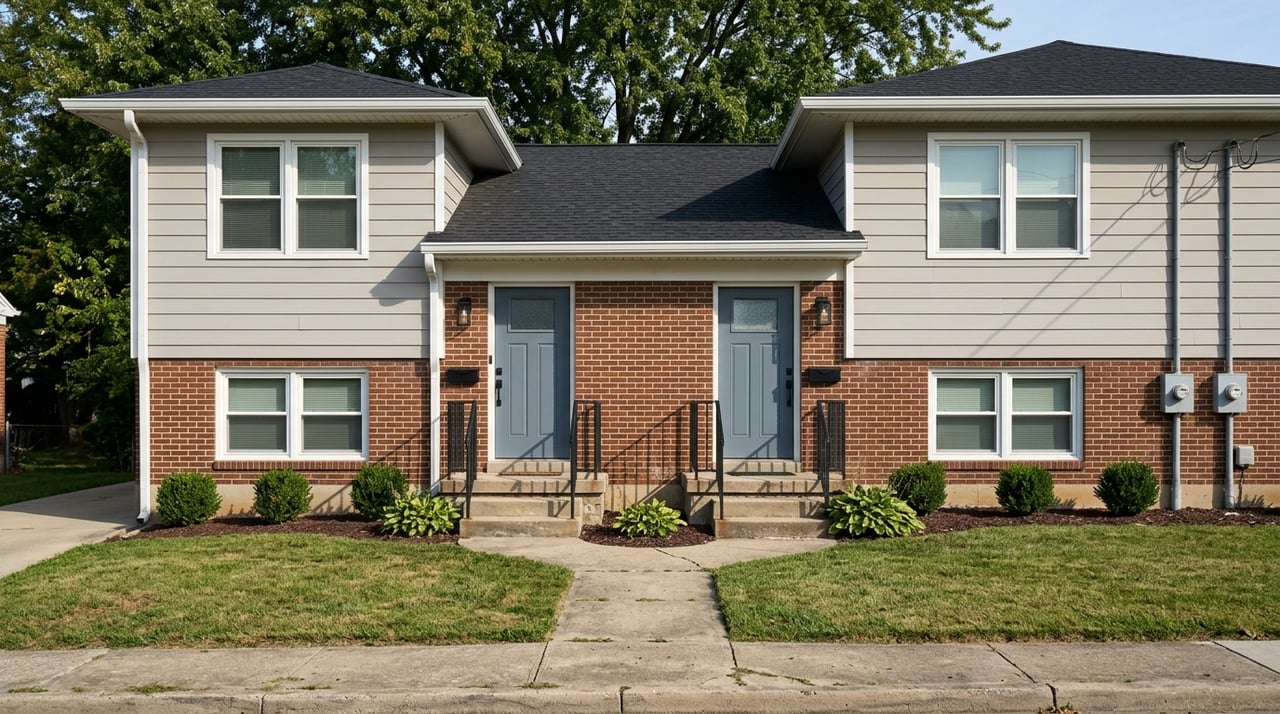
That is helpful because many older duplexes in Fort Wayne have 2-bedroom layouts. If each unit in a duplex rents for $1,113, gross monthly rent would be $2,226 and gross annual rent would be $26,712. On a $200,000 purchase price, that is about a 13.4% gross annual yield. On a $250,000 purchase price, it drops to about 10.7%.
This does not account for taxes, insurance, repairs, vacancies, or financing. Still, it shows why small multifamily can look appealing in Fort Wayne before you even consider updates or future rent growth.
How lenders view duplexes to fourplexes
One of the biggest advantages of small multifamily is that duplexes, triplexes, and fourplexes are often financed under residential 2-4 unit rules rather than commercial apartment rules. That can open the door to more familiar lending paths for some buyers.
According to Fannie Mae’s valuation guidance, the income approach is required in the valuation of 2-4 unit properties. The appraisal must include comparable rental data, comparable sales data, and a gross rent multiplier calculation. Fannie Mae also notes that an appraisal cannot rely on the income approach alone.
Fannie Mae’s rental income guidance also says rental income from the subject property may be used for a 2-4 unit principal residence when you occupy one unit, or for a 1-4 unit investment property. In some cases, a current lease can help support income if there is no rental history on tax returns.
Freddie Mac takes a similar approach. Its Small Residential Income Property Appraisal Report, Form 72, is designed for 2-4 unit properties and calls for both interior and exterior inspection of all units, with value developed through the sales comparison and income approaches.
Why that matters for your strategy
If you are planning to live in one unit and rent the others, lender treatment can be especially important. In certain cases, rental income from the other units may be added to your qualifying income. That can improve your buying power compared with a single-family purchase.
Even if you are buying strictly as an investment, the same principles apply. The lender and appraiser will care about what the units rent for, whether the rent is supported by the market, and whether the property condition supports safe, livable occupancy.
This is where appraisal-grade analysis can make a real difference. A building that looks inexpensive at first glance may not be a strong deal if market rents are weak, deferred maintenance is heavy, or the legal use is unclear.
What expenses to budget for
Gross rent is only the starting point. The IRS explains in Publication 527 that common rental expenses include maintenance, insurance, taxes, and interest. Other typical categories include utilities, repairs, advertising, legal and professional fees, and depreciation.
If you plan to house hack and live in one unit, shared expenses need even more attention. The IRS notes that for owner-occupied duplexes, shared costs such as mortgage interest and real estate taxes must be split between personal and rental use.
When you review a Fort Wayne multifamily property, ask yourself a simple question: who pays for what? That answer can change your cash flow more than a small change in rent.
Four issues that drive real returns
In Fort Wayne, small multifamily performance often comes down to four practical issues more than headline price alone. These factors affect financing, appraisal results, and your actual cash flow after closing.
Legal unit status
First, confirm the legal unit count and zoning. The research report points to one Fort Wayne property where the listing said it was being used as a duplex, while the same listing also referenced R1 zoning and tax records showing R2 duplex classification. When legal use is unclear, your financing, insurance, and resale options may become more complicated.
Rent support
Next, make sure the current or projected rent is supported by the market. Lenders and appraisers look for comparable rental data, not just an owner’s estimate. A property only works on paper if the rent is real and sustainable.
Expense structure
Then review the operating setup. The duplex at 603 Huffman St noted tenant-paid gas and electric with owner-paid water. Another local listing at 1806 Crescent Ave highlighted separate basements, separate systems, and separate metering for electric, gas, and water.
That kind of setup can matter a lot. Separate systems and meters often make management simpler and can protect your cash flow when utility costs rise.
Condition and deferred maintenance
Finally, pay close attention to condition. Freddie Mac’s Form 72 says the appraiser must identify physical deficiencies that affect livability, soundness, or structural integrity, and note adverse conditions observed during inspection.
For you, that means older roofs, dated mechanicals, foundation concerns, or poor unit separation can all affect value and financing. A cheaper purchase price may not be a bargain if the repair list is long.
Questions to ask before you offer
Before you move forward on a Fort Wayne duplex, triplex, or fourplex, use a focused checklist:
- Is the legal unit count correct?
- Does zoning support the current use?
- What leases are in place, and when do they expire?
- Are any tenants month-to-month?
- Who pays gas, electric, water, and trash?
- Are there separate meters, entrances, basements, or systems?
- What deferred maintenance is visible?
- Are there physical issues that could affect financing or insurability?
- Does the current rent appear supported by local market data?
The sample at 1728 High St, for example, showed one lower unit on month-to-month tenancy and an upper unit on a one-year lease. Details like that shape your near-term flexibility, whether you plan to raise rents, renovate, or occupy a unit yourself.
Why local analysis matters in Fort Wayne
Fort Wayne has enough pricing variety that broad rules can be misleading. One duplex may look attractive because of a low price, while another may justify a higher number because of better systems, cleaner lease structure, or stronger rent support.
That is why valuation and due diligence matter so much in this segment. You are not just buying bedrooms and square footage. You are buying an income stream, an expense profile, and a property that has to stand up to lender and appraiser review.
If you are considering a small multifamily purchase in Fort Wayne, working with a local brokerage that understands both residential valuation and investment decision-making can help you move with more confidence. Morken Real Estate Services, Inc. brings local market knowledge and appraisal-informed guidance to help you evaluate opportunities, compare value, and make smarter buying decisions.
FAQs
What counts as a small multifamily property in Fort Wayne?
- In this context, small multifamily usually means a duplex, triplex, or fourplex, which are typically handled under 2-4 unit residential lending and appraisal rules.
How can you estimate rent for a Fort Wayne duplex?
- You can start with local rent benchmarks such as HUD Fair Market Rent data and then compare that with current lease terms, unit size, condition, and comparable rental data used by lenders and appraisers.
Why does legal unit status matter for Fort Wayne multifamily investing?
- Legal unit status matters because unclear zoning or unit classification can affect financing, insurance, appraisal results, and your ability to use or resell the property as expected.
Can rental income help you qualify for a Fort Wayne duplex loan?
- In some cases, yes. Fannie Mae and Freddie Mac both allow rental income from other units to be considered for qualifying on certain 2-4 unit properties, subject to lender guidelines and documentation.
What expenses should you review before buying a Fort Wayne small multifamily property?
- Focus on taxes, insurance, maintenance, repairs, interest, utilities, legal or professional fees, and how shared costs are divided if you plan to occupy one unit.
What should you look for in a Fort Wayne duplex before making an offer?
- Review leases, utility responsibility, separate meters or systems, property condition, legal use, and whether the current or projected rent is supported by the market.